
|
|
|
|
|
| June 30, 2026 |
|
NASA announces target launch time frames for 1st moon base 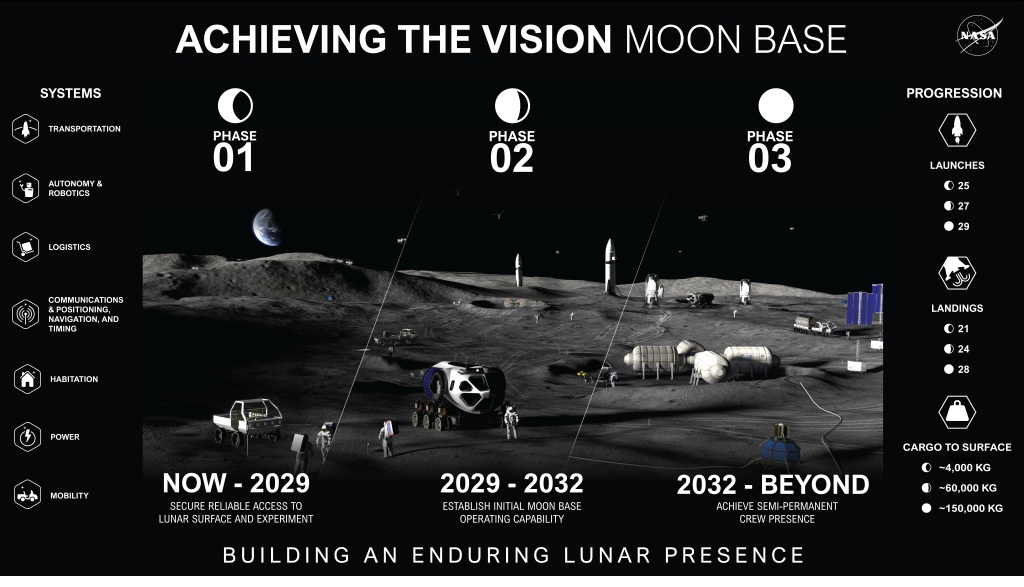
WASHINGTON - NASA on Tuesday announced target launch time frames for the first moon base ahead of the Artemis astronaut landings.
“The moon base will be America’s and humanity’s first outpost on another celestial world,” NASA Administrator Jared Isaacman said in a statement. “Every mission, crewed and uncrewed, will be a learning opportunity as we return to the lunar surface, build the infrastructure to stay, and master the skills required to live and operate in one of the most demanding and dangerous environments imaginable.” The first moon base mission will launch no earlier than fall 2026 and use a Blue Origin lunar cargo lander to deliver NASA payloads. Another launch later this year will deliver more than 1,100 pounds of cargo, and a third mission also targeted for this year will fly a payload that includes technology to study lunar swirls, or light spots on the surface of the moon, to “improve understanding of surface evolution and material behavior under extreme conditions.” What is the moon base? The moon base “will establish humanity’s first sustained presence on the moon while driving innovation, inspiring future generations and helping fuel an emerging lunar economy,” according to NASA. It will be established through three phases: - Phase One (now–2029): experiment and learn - Phase Two (2029–2032): early habitation - Phase Three (2032 and beyond): sustained human presence The first phase comes with a major increase in lunar activity, including up to 25 lunar missions to help scout the region, test technologies and prepare for surface operations. The second phase includes building semi-permanent infrastructure and initiating early habitation and logistics operations. The third phase “is when living and working on the Moon becomes a reality,” according to NASA. Where will the moon base be? The moon base will be near the lunar south pole, which has the unique environmental conditions needed to support human exploration, according to NASA. For example, parts of the south pole have long periods of sunlight, which can support solar power generation and thermal stability for exploration systems and operations. On the other hand, other areas that are under permanent shadows with cold temperatures can preserve water ice. What is the Artemis program? The moon base is a part of the Artemis program, named after the twin sister of Apollo, which aims to learn how to live on the moon so that the U.S. can safely send people to Mars. “Through Artemis, NASA will explore more of the moon than ever before and create an enduring presence in deep space, while simultaneously preparing to land the first astronaut – an American – on Mars,” according to the agency. (Source: U.S. News) Story Date: May 27, 2026
|
    |
