
|
|
|
|
|
| November 12, 2026 |
|
Dozens of California dams need repair as El Niño winter draws closer 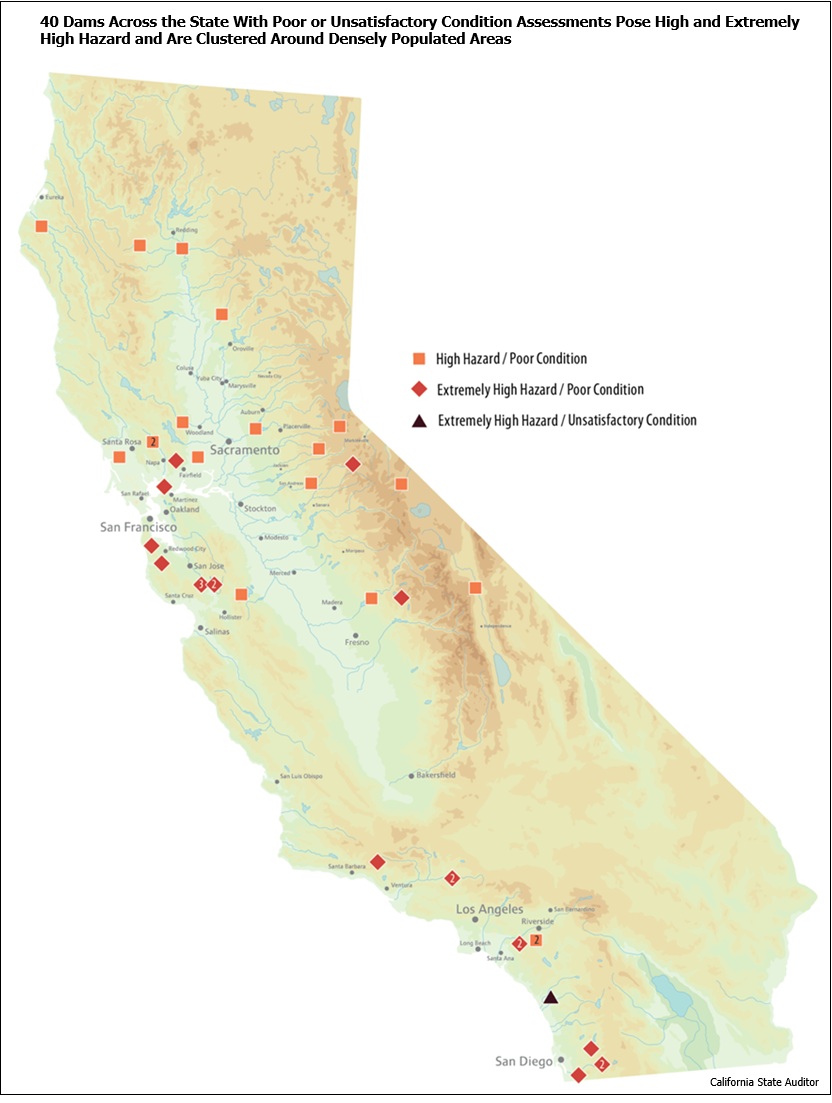
SACRAMENTO - With an El Niño winter threatening heavy rain, the State Auditor warns that California’s aging dams “continue to pose a risk to public safety,” especially in the Bay Area, San Diego, and Los Angeles areas.
An audit released Monday found 57 dams in poor or unsatisfactory condition as of May, up from previous counts. That number is likely to keep rising, as state water officials reevaluate aging dams. The 40 riskiest dams — rated high or extremely high hazard — are located throughout the state, but cluster near densely populated coastal cities. Should these dams fail, the auditor reported, “they could collectively endanger as many as 1.5 million people and cause more than $265 billion in economic damage.” Almost a decade ago, lawmakers strengthened the California Department of Water Resources’ authority to impose penalties such as reservoir restrictions, property liens, and fines when dam owners violate state safety laws and other requirements. State engineers have referred owners of 44 dams for enforcement as of April. But, the auditor wrote, the water resources department “has never taken punitive enforcement actions against dam owners that fail to remedy their violations.” Aging dams, limited funds The problem is that dams are getting older. Many were built when safety standards were softer. State laws never required dam owners to set aside funds to keep them safe, so when concrete crumbles, sediment accumulates and spillways threaten to erode under floodwaters, most dam owners lack the money for repairs. The state’s water resources department oversees the safety of more than 1,220 dams, most of them in satisfactory condition. Responsibility for maintaining the dams falls to the local governments, utilities, water agencies, and the private landowners and companies that own them. Some of the dams rated in poor condition are owned by state agencies. Disasters are extremely rare. But when they do occur, like in Oroville, or the 1928 collapse of nearly-new St. Francis dam northwest of Los Angeles — they can be catastrophic. The auditor applauded the water resources department’s inspection program but blasted its failure to enforce against dam owners who fail to meet state planning, safety or other requirements, “thereby allowing serious deficiencies to persist.” One of the cases involved a dam with a 47-foot-wide hole in its spillway that has gone unrepaired for more than 30 years, which the audit said could cause flooding affecting nearly 300 people and more than $88 million in damage. The audit doesn’t name the dam. (Source: CalMatters) Story Date: October 14, 2026
|
    |
