
|
|
|
|
|
| November 12, 2026 |
|
LA fires exposed millions to lead levels way above normal, study says 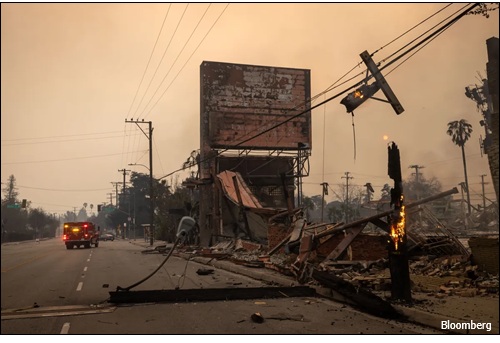
LOS ANGELES - Smoke from the devastating Los Angeles Eaton Fire last year exposed millions to very high levels of lead and other heavy metals, California Institute of Technology researchers found in a new study.
The research, published in Science Advances, adds to a growing body of evidence that the fires in Los Angeles, and other wildfires like them that break into urban areas, were uniquely toxic. During the peak of the fire, the researchers found, about 7 million residents were exposed to concentrations of lead 80 times higher than normal. (The levels were calculated across 24 hours.) The concentration of the neurotoxin in the air was shockingly high, researchers said, considering levels are typically at or close to zero. “When I first saw the lead trend, I thought I had done something wrong,” said Haroula Baliaka, lead author of the study, who recently finished her PhD in environmental science and engineering at Caltech. And it wasn’t just lead. “This is a cocktail of chemicals,” Baliaka said. The smoke also contained high levels of arsenic, chlorine, bromine, zinc and copper. Wildfires that burn at the boundary between urban and wild areas are on the rise, due to both environmental factors, such as worsened drought, and increasing suburban development. “We’re seeing that climate change is absolutely increasing these events, and the fact that there are more populated areas in that zone just makes it a higher risk,” Baliaka said. The researchers compared the fire with similar data from the 2024 Airport Fire in the Santa Ana Mountains. They found that the Eaton Fire’s smoke, which burned in a much more urban area, contained 50 times more lead. The data for the study comes from a new advanced air monitor managed by Caltech that continuously records and can detect each chemical in smoke. Researchers analyzed the contents of the smoke plume, tracked how it moved across the Los Angeles area, and then estimated how many residents were exposed. All types of fire result in smoke made of particulate matter, or very tiny particles in the air that harm people’s lungs and heart when inhaled. But usually, air monitors don’t capture what exactly those particles are made of. The smoke plume is only one way people were exposed to toxic metals and chemicals during and after the fires, said Allen, a professor of exposure assessment science at the Harvard T.H. Chan School of Public Health. “The health risks don’t end when the fire is put out,” he said. In the aftermath of the L.A. fires last year, researchers have found high levels of a carcinogenic toxic metal that lingered in the air for months, increased levels of lead in soil and elevated levels of air pollution indoors, among other findings. (Source: The Washington Post) Story Date: October 28, 2026
|
    |
